
Alex Thawani1, Dzinkambani Kambalame1,2, Jim Mtambo3 Fanuel Lampiao4, Waluza Mwafulirwa5, Chriford Nyando6, Adamson Sinjani Muula2
- Public Health Institute of Malawi, Research Division, Ministry of Health and Sanitation, Lilongwe, Malawi
- School of Global and Public Health, Department of Community and Environmental Health, Kamuzu University of Health Sciences, Blantyre, Malawi
- Library Department, Kamuzu University of Health Sciences, Lilongwe, Malawi
- Department of Biomedical Sciences, School of Life Sciences and Allied Health Professions, Kamuzu University of Health Sciences, Blantyre, Malawi.
- School of Medicine and Oral Health, Department of Clinical Sciences, Kamuzu University of Health Sciences, Blantyre, Malawi
- Department of Adult Health Nursing, Kamuzu University of Health Sciences, Lilongwe, Malawi
Corresponding Author: Email*: Alex Thawani, alexthawani@gmail.com
Abstract
Background: Cardiovascular conditionsand diseasesare among the most common and consequential conditions affecting aging or older populations. Health systems readiness to provide care and support is critical as populations age.
Objective: This scoping review seeks to map extant evidence on health system readiness to support healthy aging among older adults with cardiovascular diseases in low and middle-income countries.
Methods: The review will be conducted following the Joana Briggs Institute critical appraisal checklist for conducting scoping reviews. Literature searches will be initially conducted from the following databases: PubMed, CINAHL, Web of Science, EMBASE, and Scopus. Citation tracing will also be used to identify studies cited in the papers retrieved from the initial search. The Search Strategy will use keywords, as well as related terms identified and merged using the Boolean operators AND as well as OR. Rayyan software will be used to facilitate the screening process of the articles. The review will follow the blinded review process whereby two independent reviewers will review the titles, abstracts and full texts. In cases of disagreement, a third reviewer will be engaged and discussions will be initiated to address disagreements. The Systematic reviews and Meta-Analyses extension for Scoping Reviews (PRISMA-SCR) will be used to report the process.
Ethics and dissemination: Ethical approval is not required because this review will use publicly available literature. Findings will be disseminated through a peer-reviewed publication, conference presentation and stakeholder engagements to inform policy, practice and future research on healthy ageing and CVD care in LMICs.
Introduction
Cardiovascular diseases are among the leading causes of mortality and morbidity worldwide 1. An estimated 19.8 million people died from CVDs in 2022, representing approximately 32% of all global deaths 2. Globally, cardiovascular disease-related fatalities soared by 60%, rising from 12.1 million in 1990 to 20.5 million in 2021, accounting for nearly one-third of all deaths 3. Older age is a major risk factor for cardiovascular diseases 4.
The surge in cardiovascular conditions among aging adults is influenced through several pathways, including functional changes in the heart and blood vessels resulting in diastolic and systolic dysfunction, as well as electrical instability leading to arrhythmias 4. These pathologies stem from interconnected mechanisms such as escalated oxidative stress, chronic inflammation, harmful apoptosis, and progressive myocardial deterioration and fibrosis 3,4.
At least 80% of the world’s older adults face the burden of non-communicable diseases (NCDs) such as cardiovascular diseases amid constrained resources 5. Approximately 80% of the world deaths from CVDs occur in low- and middle-income countries. There is therefore a need for healthy aging NCD interventions in low and middle-income countries. Health aging entails creating strategies that allow people to be and accomplish what they value throughout their lives6.
Addressing healthy aging amid the escalating incidence of cardiovascular conditions demands comprehensive measures, including strategic resource allocation, targeted health literacy and individual and public lifestyle interventions, and infrastructural development 7,8. It further entails strengthening primary care infrastructure with age-friendly facilities, equipping health workforces with CVD-specific training, and scaling digital health tools for remote monitoring and early detection 7,9. Equally, interventions supporting medication adherence, and integrating geriatric care into universal health coverage play a role for promoting healthy aging 3,10.
This scoping review seeks to map evidence on health system readiness to support healthy aging among older adults with cardiovascular diseases in low and middle-income countries. Health system readiness is critical to allow for the implementation, monitoring and evaluation of interventions.
Review questions
- How are health systems supporting healthy aging among older adults with cardiovascular diseases in LMICs?
- What are the enabling factors that enhance health system readiness in supporting healthy aging among older adults with cardiovascular diseases in low and middle-income countries?
- What are facilitators and barriers that hinder health systems readiness to support healthy aging among older adults with cardiovascular diseases in LMICs?
Inclusion criteria
This review will be guided by the Participant, Context and Concept (PCC) to guide the development of the inclusion and exclusion criteria as well as defining the scope.
Population: Studies will be eligible if they focus on older adults, defined as people aged 60 years and above, living with cardiovascular disease. Studies including mixed adult age groups will be included only if data for older adults are reported separately or if the article explicitly addresses care for older adults or ageing populations. Cardiovascular conditions or disease will include, but not be limited to coronary artery disease, heart failure, hypertension when examined as a cardiovascular care condition, stroke, atrial fibrillation and other clinically defined cardiac or vascular diseases.
Concept: The review will include studies addressing health system readiness, preparedness, capacity, responsiveness or closely related constructs relevant to supporting healthy ageing among older adults with cardiovascular disease. This will include evidence on service delivery, health workforce, infrastructure, medicines and diagnostics, digital health, financing, governance, continuity of care, rehabilitation, age-friendly care, and reported barriers and facilitators.
Context: Studies conducted in countries classified as low- and middle-income countries according to the World Bank classification at the time of the article will be included.
Types of sources: The review will include quantitative, qualitative and mixed-methods primary studies, implementation studies, health systems assessments and relevant policy or programme reports. Systematic reviews will not be included as evidence sources but their reference lists will be screened to identify additional eligible primary studies. Editorials, commentaries, conference abstracts without sufficient methodological detail, opinion papers and protocols will be excluded.
Limits: Only studies published in English will be included. The search will be limited to studies published from 1 January 2000 onwards to December 31st 2025 to capture contemporary health system arrangements relevant to ageing and cardiovascular care.
Methods
The scoping review will be conducted to provide a broader understanding of the healthcare systems’ readiness in support of the health aging among older adults with cardiovascular diseases in low and middle-income countries. The Joana Briggs Institute (JBI) standard for conducting scoping reviews will be followed, to provide the step-by-step process for conducting the exercise. The JBI introduced more essential guidelines that aid development of a scoping review in a rigorous manner as well as an essential reporting process 11. The steps as proposed by the JBI include Development of the Searching strategy, initiating the article selection process, data extraction and data analysis and presentation 12.
Search strategy development
The advanced search, containing controlled vocabulary as well as uncontrolled vocabulary, will be developed. The Search strategy will be developed by a librarian (JM). Keywords and synonyms will be identified and combined. The Boolean operator AND will be used to join the keywords, while the Boolean operator OR will be used to join the synonyms. Truncations will be used to enhance the search strategy to ensure the precision of the search across the databases. The following are the key words that will be used: readiness, health systems, healthy aging, older adults, and cardiovascular diseases. The following synonyms will be used: preparedness, capacity, capability, healthcare systems, health services, health sector, successful aging, active aging, positive aging, elderly, older people, aged population, senior citizens, aging population, older persons, geriatric population, heart diseases, cardiovascular conditions, heart and circulatory diseases, cardiac diseases.
The literature search will be conducted in the following databases: PubMed, CINAHL, Web of Science, EMBASE, and Scopus. Citation tracing will also be used to trace the studies cited in other studies.
Draft PubMed search string
((“Aged”[Mesh] OR “Aged, 80 and over”[Mesh] OR older adult* OR older people OR older person* OR elderly OR ageing OR aging OR healthy ageing OR healthy aging)
AND
(“Cardiovascular Diseases”[Mesh] OR cardiovascular disease* OR heart disease* OR cardiac disease* OR coronary artery disease OR heart failure OR stroke OR hypertension OR atrial fibrillation)
AND
(“Health Services Accessibility”[Mesh] OR “Health Services for the Aged”[Mesh] OR “Delivery of Health Care”[Mesh] OR “Health Resources”[Mesh] OR health system* OR health service* OR service readiness OR system readiness OR preparedness OR capacity OR capability OR workforce OR financing OR governance OR information system* OR age-friendly care OR continuity of care OR rehabilitation)
AND
(“Developing Countries”[Mesh] OR low-income countr* OR middle-income countr* OR LMIC* OR resource-limited setting*))
Article selection
The articles retrieved from each database will be extracted in Research Information System (RIS) format. The articles will be imported into Rayyan web based software to aid in the screening and selection process 13. Prior to screening, duplicates will be identified and removed.
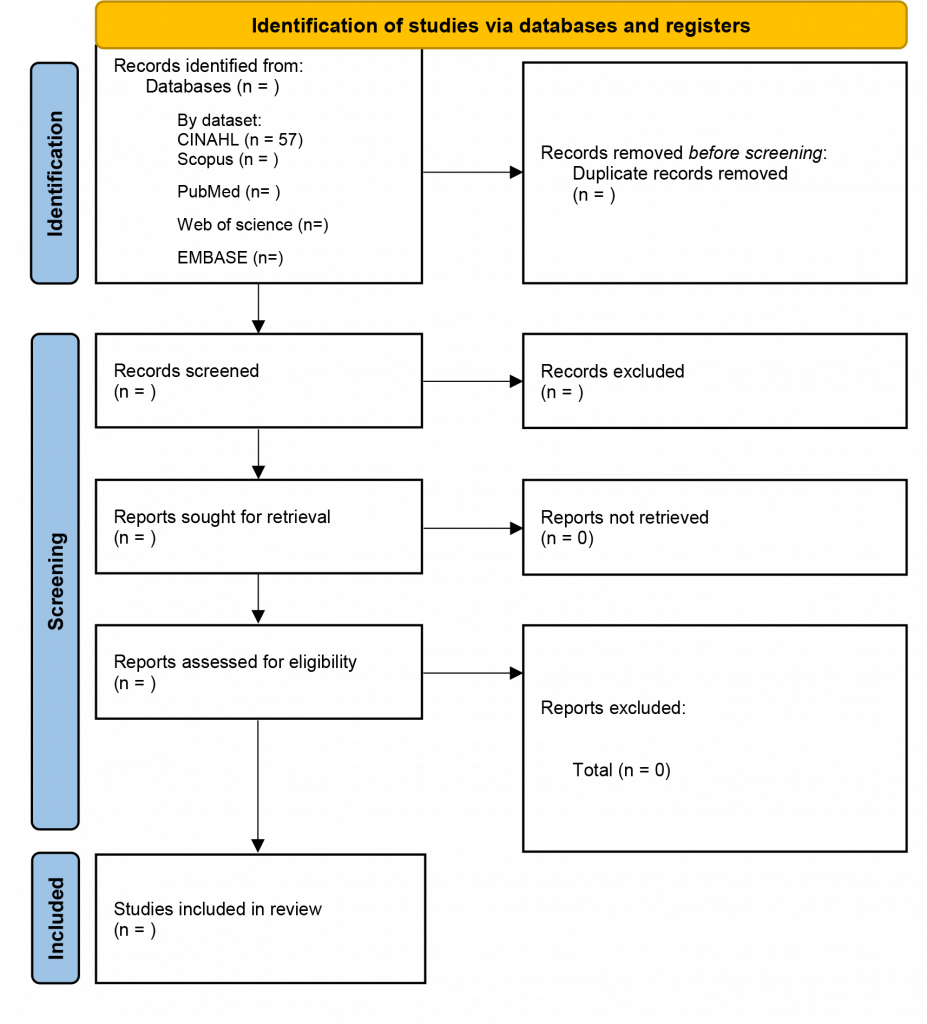
The screening will follow the blinded review process whereby two independent reviewers will screen the titles and abstracts for inclusion and exclusion. The conflicts with regard to selection will be resolved through a thoughtful discussion. Where consensus will not be reached, a third reviewer will be engaged to serve as an arbitrator. The full technical review will also involve the two independent reviewers screening the full text studies, where the decisions regarding inclusion and exclusion will be resolved through discussion, the arbitrator will be engaged where a consensus could not be reached. The Preferred Reporting Items for Systematic Reviews and Meta-Analyses extension for Scoping Reviews (PRISMA-SCR) will be used to report the process.
Data extraction
The data extraction process will be initiated by the two independent reviewers, who will extract the critical information from the articles that meets the inclusion criteria. The data extraction tool will be designed by JM and AT, in line with the tools that were used in previous scoping reviews of a similar nature. All authors will be engaged to assess the practicality of the tool prior to its adoption. The feedback from the assessment will be incorporated and necessary modifications will be made. The data extraction tool will include: authors, title, year of publication, country of origin, aims of the article, sample size, methodology used, and key findings relevant to health system readiness with respect to ageing and cardiovascular diseases.
Data analysis and presentation
The data extracted from the key findings will be coded and analysed using content analysis. The results will be summarised and described narratively.
Discussion
The review will map existing evidence on health systems readiness to support healthy aging among older adults with cardiovascular diseases in low and middle-income countries. The evidence generated from the review will offer an understanding of how the health systems are prepared or equipped to support healthy aging among older adults with cardiovascular diseases. It will further offer an understanding of the existing barriers hindering the provision of adequate support. The results would inform policy as well as practice that would enhance support for aging among older adults with cardiovascular diseases in health care facilities.
Conclusion
In conclusion, the review will offer a deeper understanding of the readiness of healthcare facilities, such as tertiary facilities, secondary as well as primary healthcare facilities in supporting the older adult patients with cardiovascular diseases. It will offer an insight into the availability of resources, human resources, expertise and other interventions in enhancing healthy aging among older adults with cardiovascular diseases. It will further highlight the existing gaps in terms of interventions, policy, as well as practices.
Limitations
The review will focus on articles from studies conducted in low and middle-income countries. This, may limit having a deeper understanding of the issues surrounding health aging among adult patients with cardiovascular conditions in other regions, such as high-income countries. Additionally, language restrictions may limit having evidence from relevant studies in languages other than English. Furthermore, the review will include studies published within a period of 1 January 2000 onwards to December 31st 2025 to capture contemporary health system arrangements relevant to ageing and cardiovascular care. The relevant studies with essential information published outside this period will be excluded.
Author contributions
All authors contributed to the writing on the protocol. AT and JM will lead the data extraction exercise.
Funding
The study will be conducted with funding through the Africa Center of Excellence in Public Health and Herbal Medicine (ACEPHEM) at the Kamuzu University of Health Sciences (KUHeS), Malawi.
Competing interests
None declared.
References
1. Zhou M, Zhao G, Zeng Y, Zhu J, Cheng F, Liang W. Aging and Cardiovascular Disease: Current Status and Challenges. Rev Cardiovasc Med. 2022 Apr 8;23(4):135. doi:10.31083/j.rcm2304135 PubMed PMID: 39076212; PubMed Central PMCID: PMC11274005.
2. Cardiovascular diseases (CVDs) [Internet]. [cited 2026 Mar 23]. Available from: https://www.who.int/news-room/fact-sheets/detail/cardiovascular-diseases-(cvds)
3. Asefa ET, Gemmechu TD, A/fogi MM, Tukeni KN. Increase in Cardiovascular Disease Mortality in Low- and Middle-Income Countries: A Time for Action. Ethiop J Health Sci. 2025 Jan;35(1):1–2. doi:10.4314/ejhs.v35i1.1 PubMed PMID: 39981327; PubMed Central PMCID: PMC11837790.
4. Rodgers JL, Jones J, Bolleddu SI, Vanthenapalli S, Rodgers LE, Shah K, et al. Cardiovascular Risks Associated with Gender and Aging. J Cardiovasc Dev Dis. 2019 Apr 27;6(2):19. doi:10.3390/jcdd6020019 PubMed PMID: 31035613; PubMed Central PMCID: PMC6616540.
5. Basto-Abreu A, Barrientos-Gutierrez T, Wade AN, Oliveira de Melo D, Semeão de Souza AS, Nunes BP, et al. Multimorbidity matters in low and middle-income countries. J Multimorb Comorb. 2022 Jun 16;12:26335565221106074. doi:10.1177/26335565221106074 PubMed PMID: 35734547; PubMed Central PMCID: PMC9208045.
6. Healthy ageing and functional ability [Internet]. [cited 2026 Mar 23]. Available from: https://www.who.int/news-room/questions-and-answers/item/healthy-ageing-and-functional-ability
7. Schmanske N, Ngo JM, Kalra K, Nanna MG, Damluji AA. Healthy ageing in older adults with cardiovascular disease. Eur Heart J. 2025 Jul 7;46(26):2536–51. doi:10.1093/eurheartj/ehaf231 PubMed PMID: 40296653; PubMed Central PMCID: PMC12233012.
8. Rony MKK, Parvin MstR, Wahiduzzaman Md, Akter K, Ullah M. Challenges and Advancements in the Health-Related Quality of Life of Older People. Advances in Public Health. 2024;2024(1):8839631. doi:10.1155/2024/8839631
9. Maddula R, MacLeod J, McLeish T, Painter S, Steward A, Berman G, et al. The role of digital health in the cardiovascular learning healthcare system. Front Cardiovasc Med. 2022 Nov 3;9:1008575. doi:10.3389/fcvm.2022.1008575 PubMed PMID: 36407438; PubMed Central PMCID: PMC9668874.
10. Shinkai S, Yoshida H, Taniguchi Y, Murayama H, Nishi M, Amano H, et al. Public health approach to preventing frailty in the community and its effect on healthy aging in Japan. Geriatrics & Gerontology International. 2016;16(S1):87–97. doi:10.1111/ggi.12726
11. Hadie SNH. ABC of a Scoping Review: A Simplified JBI Scoping Review Guideline. Education in Medicine Journal. 2024 Jun 30;16:185–97. doi:10.21315/eimj2024.16.2.14
12. Peters MDJ, Marnie C, Tricco AC, Pollock D, Munn Z, Alexander L, et al. Updated methodological guidance for the conduct of scoping reviews. JBI Evidence Synthesis. 2020 Oct;18(10):2119. doi:10.11124/JBIES-20-00167
13. Rayyan: AI-Powered Systematic Review Management Platform [Internet]. [cited 2026 Mar 23]. Available from: https://www.rayyan.ai/